

Letter #171: Tom Morgan (2024)
Director at Sapient Capital | The Most Offensively Taboo Idea in Western Civilization


Hi there! Welcome to A Letter a Day. If you want to know more about this newsletter, see "The Archive.” At a high level, you can expect to receive a memo/essay or speech/presentation transcript from an investor, founder, or entrepreneur (IFO) each edition. More here. If you find yourself interested in any of these IFOs and wanting to learn more, shoot me a DM or email and I’m happy to point you to more or similar resources.
If you like this piece, please consider tapping the ❤️ above or subscribing below! It helps me understand which types of letters you like best and helps me choose which ones to share in the future. Thank you!
Today’s letter is the transcript and slides of a speech Tom Morgan gave at the Sohn Conference this past week on curiosity. This was the result of 10 years of research that Tom had spent 3 months compressing into a 20 minute presentation… and further compressing it into 5 minutes. As a result, it’s one of the tightest, information-dense, and thought provoking talks I’ve listed to. One thing’s for sure… follow your curiosity.
Tom Morgan is Sapient Capital’s Director of Client Communications and Marketing. Prior to joining Sapient, Tom was the Director of Communications and Content, The KCP Group at Stifel, which he joined after a stint as a Research Provider Relationship Manager at Liquidnet. Before Liquidnet, Tom was a founder, having started and operated Personal Best NYC. Prior to becoming a founder, Tom was an equity product manager at Consumer Edge, a Managing Director at Stifel, and a Director at Merrill Lynch.
[Transcript and any errors are mine.]
Related Resources
Sohn Conference
Transcript and Slides

So I'm not going to talk about a stock today. Instead, I'm going to talk about the most offensively taboo idea in western civilization.

This is Dr. Ian McGilchrist. He wrote, probably the most interesting book I've ever read, The Matter with Things. His focus of his very long career has been the two hemispheres of the brain. Now, you're probably thinking this brain hemispheres stuff has been debunked. It hasn't. It's just nuanced.

The brain's left hemisphere is narrowly focused. It uses language, it is linear, and it is logical. The brain’s right hemisphere, it sees the whole picture. But it has very little use of language. It is emotional, and intuitive.
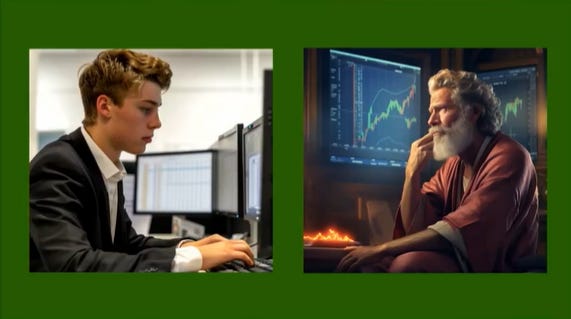
I like to think of the left hemisphere as like a junior analyst. Amazing modeling, but lives in the model. The right hemisphere is the intuitive Druck, Soros type that makes these amazing, instinctive decisions, but can't always explain why.

Now, you need both of them--but you don't let the junior analyst run the hedge fund; he will burn it down.

Which is unfortunate. Because McGilchrist's diagnosis is the world is imbalanced towards the brain's left hemisphere. The brain's left hemisphere deals in abstractions. And there's nothing wrong with that. That's why you're all sitting here today.

But taken to an extreme, abstraction leads to disconnection. Disconnection from our environment, our bodies, and each other. And frankly, when I look at the world and its various problems, I can see almost no crisis that isn't being caused, in some part, by disconnection.

How does this happen?

Well, if you experimentally suppress the brain's left hemisphere for 10 to 15 minutes, people start to see things they would ordinarily see as dead as alive. So the sun going across the sky giving you energy, the world becomes more animate. But if you experimentally suppress the brain's right hemisphere for 10 to 15 minutes, people start to see living things as dead. So other human beings become like zombies, or machinery, or furniture.

The implication, if we're already too far over on the left, is that the world is more alive, and we are more connected to it, than we typically think.

And so the taboo. There might, might, be an intelligent, benign force guiding our attention.

Why is this so offensively taboo? Well, we reject any external challenges to our intellect. The left hemisphere by nature, is competitive. It lies, and it denies the existence of anything more intelligent than itself. I think we all know those people.
But there is a problem. Which is our intellect alone cannot navigate the world.

The world is what's called combinatorial explosive, which just means too many choices, too little time. Rational trial and error cannot have worked. If we weighed up the pros and cons of every decision in high stakes environments, the tiger would have beaten us.

The analyst knows all the numbers, but the PM knows what's relevant. But how do we know what's relevant all the time? Our environment helps signal it to us. What we are attracted to narrows our options. We all intuitively understand this in romantic relationships, but I believe the same applies to information.

Evolution's solution to combinatorial explosiveness is curiosity. Now, the dictionary definition of curiosity is: "a strong desire to know or learn something."
A definition that I find rubbish. Doesn't tell you anything.
"A strong desire."
Where does it come from?
"To learn something."
To learn what?
Question: please ask yourself, and I do mean, please ask yourself--this is not a rhetorical device. Can you force yourself to be interested in something? Can you force yourself to be interested in something?

Wine tasting. Accountancy. Cricket. The Real Housewives of New Jersey.
The fact is, is that everything we're interested in and passionate about exists upon a continuum, but we're not in full control of that.
If you don't fully control your interests, what does?

I believe that curiosity is a relational, a two way force between you and your environment.

Evolution, in the form of curiosity, helps guide you into a unique niche. It's why you don't have full control of it, and why pursuing it feels good.
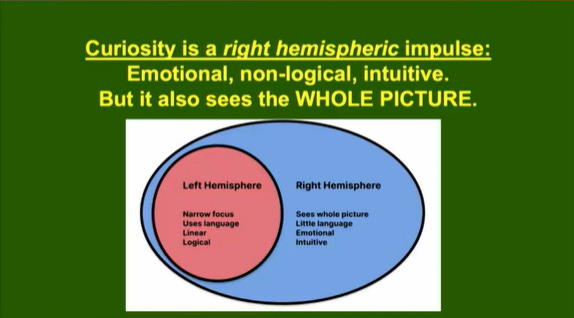
Curiosity is a right hemispheric impulse. It connects you to the world. It is emotional, it is non logical, it is intuitive. But it also sees the whole picture.

In fact, McGilchrist's conclusion: the right hemisphere is responsible for, in every case, the more important part of our ability to come to an understanding of the world.

But don't forget: the left hemisphere always denigrates the contributions of the right. Particularly as they're fuzzy, emotional, nonverbal. So following your curiosity requires faith.

But I will leave you with probably my most heretical belief: curiosity may also be mysteriously rewarded by your environment. The favorite quote of my life is from the great mythologist Joseph Campbell: "Follow your bliss and doors will open where they were only wolves."

I can't prove anything in five minutes, but I hope you might now take your curiosity more seriously.
Thank you.
If you got this far and you liked this piece, please consider tapping the ❤️ above or sharing this letter! It helps me understand which types of letters you like best and helps me choose which ones to share in the future. Thank you!
Wrap-up
If you’ve got any thoughts, questions, or feedback, please drop me a line - I would love to chat! You can find me on twitter at @kevg1412 or my email at kevin@12mv2.com.
If you're a fan of business or technology in general, please check out some of my other projects!
Speedwell Research — Comprehensive research on great public companies including Constellation Software, Floor & Decor, Meta, new frameworks like the Consumer’s Hierarchy of Preferences (Part 1, Part 2, Part 3), and much more.
Cloud Valley — Easy to read, in-depth biographies that explore the defining moments, investments, and life decisions of investing, business, and tech legends like Dan Loeb, Bob Iger, Steve Jurvetson, and Cyan Banister.
DJY Research — Comprehensive research on publicly-traded Asian companies like Alibaba, Tencent, Nintendo, Sea Limited (FREE), and more.
Compilations — “A national treasure — for every country.”
Memos — A selection of some of my favorite investor memos.
Bookshelves — Your favorite investors’/operators’ favorite books.
I really think Feynman and Kauffman and generally complexity theory properly understood address the issue McGilchrist is going after… and which he can’t get to from where he starts.
First Feynmans beauty of a flower is useful. Scientific understanding properly applied is expansive - it explodes the dimensions of information - not reductive.
Second, Kauffmans World Beyond Physics is useful. As Morgan states the world is combinatorially explosive. But his and McGilchrists conclusions are wrong, or they miss what is truly amazing. As Kauffman points out, the chemical combinations needed to develop simple life happened much more quickly than one would expect from random interactions. Kauffmans conclusion is that for unknown reasons we happen to live in a universe whose structure is such that we happened naturally. This is as weird as it sounds. Kauffmans conclusion is that the universe itself is creative and we are creative beings in a creative universe.
McGilchrist is interesting - and our brains are crazy and amazing… but there is also an element that is left out around Schrodingers What is Life in that life locally violates the second law of thermodynamics by organizing and concentrating energy in space and time. You and I, each of us is roughly 10 to the fourth power (10,000) times more energy dense than the sun per unit mass (Rob Philips lecture). This is done through control and regulation and structure.
So is it surprising that our brains incorporate a domain for reinforcing and extending the sort of structure which created life by concentrating energy in space and time? We need structure.
And that our brains also see the connections, because we ourselves, each of us, are just different branches of a complex interconnected web of self-reinforcing and iteratively evolving chemical reactions which began as life on earth a few billion years ago, and which somehow the laws of the universe we live in were structured to create. The invisible hand or force isn’t reaching in. It’s always there in how physics and chemistry work.
Anyway - Morgan’s presentation is amazing. I just think McGilchrist only gets halfway to the interesting insight that we are creative beings in a creative universe.
And the real punchline is that our technologies are really just beginning to enable us to use our creativity. We are still just at the beginning.
As a native Kansan, I am naturally inclined to find midwesterners to be a source of wisdom. So, when I think about the competitive advantages of curiosity I can help think of this scene from Ted Lasso:
https://youtu.be/5x0PzUoJS-U?si=YjByIimhMUi5WO8D
And I think we do have to think of curiosity as a social trait which is selected for or against as part of cultural evolution via group competition.
And what is interesting about our current time period is the way our global networks are enabling new ways of forming and collaborating groups - changing the dynamics of group competition and the course of cultural evolution.
But you can also just enjoy the humor and remember to be curious not judgmental. Be Ted, not Rupert.